Monday, 11 February 2013

Natalie Bennett Green Party Leader visits Huddersfield

Last week new Green Party Leader Natalie Bennett visited Huddersfield to look at some of the things we've acheived here in Kirklees, areas we are concerned about and to speak at a public meeting hosted by Huddersfield Young Greens. Natalie is turning out to be a competent a capable Leader for the party and it was good of her to to come up North on what was a freezing day. I didn't vote for Natalie in the Green Party's internal elections for Leader but I'm happy to say she's doing a cracking job. Thanks to Shan Oakes (second place on the Euro List) for the photos.

Natalie helps out with the thousand fruit tree project in Farnley Tyas

At Hillside School Newsome from Left Gideon Richards, Karen Allison, Shan Oakes, Natalie and yours truly
A visit to Stirley Farm in Newsome to look at the new Passivhaus Barn being built by the Green Building Company - it was very cold!

Natalie on form following a busy day and a curry
Me in full flow at Huddersfield Student Union

Friday, 8 February 2013

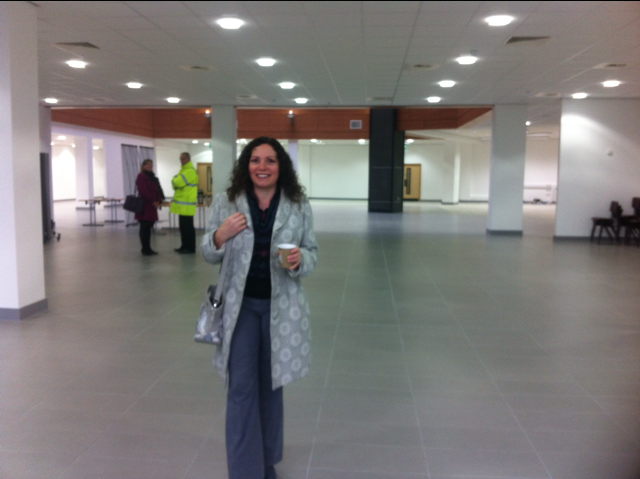
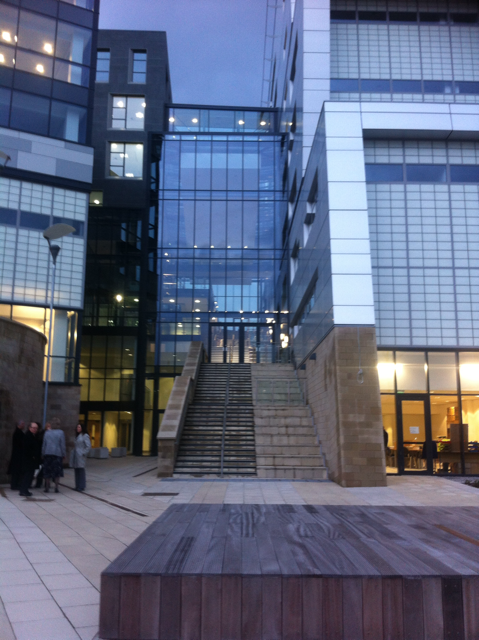
Kirklees College arrives in port - Sneak Peek Pics


Kirklees College - reminiscent of the decks of a luxury liner?

Councillor Julie Stewart-Turner in the entrance area - just add students

A view inside the atrium

The new throughroute from Manchester Road to the canal and Chapel Hill

and viewed from the canal


Thursday, 7 February 2013

Flooding evidence to the EFRA Select Committee


I’m just back from my appearance in the Houses of Parliament on the EFRA Select Committee looking into the hot issue of flooding. Since becoming the Chair of the Local Government Association’s Inland Flood Risk Working Group we have wrestled with many aspects of central and local government approaches to the issue just as some of the worst flooding events ever experienced were hitting towns and vilages up and down the country. In all around 7,800 homes were flooded and some more than once.
One of the first issues raised by the Select Committee's Chair Ann Mcintosh MP was whether or not the funding provided by government was meeting the need for flood prevention measures. I pointed out the fact that the additional £120 million provided by government for schemes was a ‘drop in the ocean’ and that the flood alleviation scheme for Runnymede alone would cost around £200million. I was asked about the effectiveness of the Bellwin scheme - central government funding for flood hit councils. After a flood event such as hit Calderdale last year was not unusual to see government ministers giving interviews mentioning how central government emergency funds will be brought in under the Bellwin scheme to help out local Councils. To qualify for the scheme the damage must cost more than around 2% of a Councils annual budget. Millions of pounds worth of funds have to be incurred by Councils before they can be considered for Bellwin assistance. There are also an awful lot of items not covered by the Bellwin scheme such as damage to rads and infratructure. Calderdale incurred costs of around £2.5million following the Hebden Bridge/Todmorden Floods but under the Bellwin formula only qualified for around £80k. I was also probed about how Partnership funding was working. This is where central government funding for flood defences is matched against other sources such as private and Council funding. In many places there are no large companies to put their hand in their pocket to cover the cost of defences so often costs can fall on cash strapped councils or private householders. It is possible that some worthy schemes where there is a need for flood defences might fail due to lack of support funding and less worthy schemes are prioritised.
After making these points one of the MP’s on the Committee (Conservative I’m guessing) asked me what I would cut to pay for flood defences. As he was asking (and I was trying to be helpful) I suggested cutting the billions of pounds being allocated to HS2 and Trident. He didn’t probe deeper. Maybe he agreed.

Here's a link to video footage of the meeting

http://www.parliamentlive.tv/Main/Player.aspx?meetingId=12535


Saturday, 2 February 2013

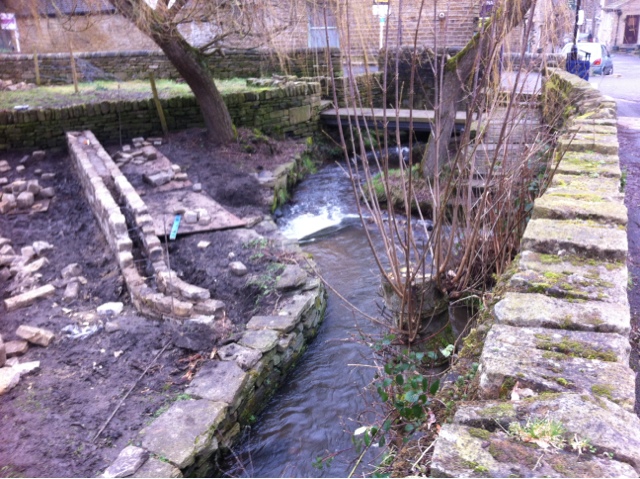
More progress on Armitage Bridge Flood wall

A stone lintel goes in next week but here's progress to date. Great to see this happening.

Tuesday, 29 January 2013

PRESS RELEASE - Andrew Cooper to contest Euro Elections for the Greens


Kirklees Green Councillor Andrew Cooper has been selected by Yorkshire and Humber Green Party as Lead Candidate in the 2014 European Elections in a vote of Party members from across the region.
Andrew has been a Green Party Councillor in on Kirklees Council since 1999 and has been re-elected 4 times. There are now 5 Greens elected to Kirklees Council. Andrew’s proudest achievement has been establishing the UKs first universally free insulation scheme which insulated over 50,000 homes in Kirklees. In 2008, in recognition of his work promoting sustainable energy, Andrew was named as one of the UKs top 100 Environmentalists (number 59) in the Independent on Sunday’s Green List. Andrew is also the national Chair of the Association of Green Councillors which has over 130 Councillors from around the country. He is the Green Party’s National Spokesperson on Energy and Climate Change
On his selection Andrew said,
“I am pleased to have been selected by the Green Party to contest these elections in 2014. If elected, I would seek to ensure more European funds are levered into our region to promote jobs and economic security. We want to ensure that more people are able to work in the expanding green technologies sector.  This will help not just employment but peoples fuel bills through improved energy efficiency. We will work hard to give more young people hope of secure worthwhile employment.  We need jobs which are fulfilling, improve society and help protect our local and global environment.”
In the last European Elections the Greens only narrowly missed gaining an MEP seat by 1.3% in the Yorkshire and Humber region. Since then support for the BNP and the Liberal Democrats has waned giving the Greens a real chance of electing their first MEP in the region. The Green Party already has 2 MEPs in the European Parliament representing London and the South East. The European Elections are conducted under a list system of proportional representation
In Yorkshire and the Humber the Green Party now has 15 Councillors on 6 Councils in Yorkshire including Sheffield, Kirklees, Bradford, Leeds, Scarborough and York.
ENDS

Saturday, 26 January 2013

40 years of the CAT

CATs Kim Bryan, Paul Allen and myself at the Environment Question Time
It can take a long time to get to the Centre for Alternative Technology (CAT) near Machynlleth.It is in deepest North Wales on the site of an old slate mine about 10 minutes bus ride from the town centre. It is its distance and semi isolation which adds to its mystique within the Green Movement. If you are going to go on a pilgramage to a place which was the springboard for a lot of the pathfinding work on 'green living' you don't necessarily want it to be easily accessible . A degree of remoteness adds to its status as a place set apart from the modern world where new ideas and ways of living could be explored free from distractions in an almost monastic way. I reckon I've been to CAT around half a dozen times, usually taking the water powered train /lift carraige. When you get to the top it is an alternative technology theme park dealing with environmentally friendly ways of growing food, dealing with waste and generating energy.

At the time the first pioneers went there in the early 70s we had a backdrop of the international oil crisis and concern about the 'population bomb' affecting our life support systems. Whilst in London, 70s politicians were  having 'beer and sandwiches' in Machynlleth the CAT pioneers with 'beards and sandals' were taking the first steps in establishing sustainable new ways of living in a modern world. My latest journey to CAT earlier this month was as a visiting lecturer on one of their Architecture courses talking about 'The politics of sustainable energy' drawing on my experience at the local and national level getting projects off the ground in an ever changing policy landscape.

For all its isolation CAT is not isolationist. It actively seeks novices to learn the technicalities and practicalities of integrating sustainable technologies in our communities. To help acheive this CAT have recently opened a purpose built educational facility, the Welsh Instititute for Sustainable Education (WISE), with lecture theatres seminar rooms and accomodation for visiting students. It is of course built to the highest environmental standards but this is further enhanced by its location which was particularly stunning with the addition of the snow that fell during my stay there. On the evening following my talk there was environmental question time for the students with myself and CATs Paul Allen and Kim Bryan where we asked a range of questions looking at some of the issues we'll be facing getting the green message across over the next 40 years. I left CAT in the snow impressed by their ongoing role as a biomassed fuelled crucible of ideas and passion rooted in the 1970s but still way ahead of their time.

And here from the 1970s is Al Stewart's 'Year of the Cat'. What else?


Wednesday, 23 January 2013

Bins, Pickles, Fracking and Chicken Tikka Masala


As eaten by Eric Pickles
 One issue that has been concentrating the minds of the Local Government Association's Environment and Housing Board is the issue of weekly bin collections for grey bins. This ‘interest’ is not our own but that of the Communities and Local Govt Minister Eric Pickles. He has said something along the lines of it being everyones right to have the remains of their Chicken Tikka Masala collected once a week by the Council. Many Councils, like Kirklees have transferred to bi-weekly collections for grey bins for a number of years now. This has been motivated by a desire to cut costs in response to budgetary pressures and also to increase the drive for householders to recycle more of their household rubbish. To incentivise Councils to go back to weekly bin collections Mr Pickles announced a £250 million fund to help councils to convert back. He has also stated in the Daily Mail (where else) that further cuts could come to councils who do not go back to weekly bin collections. So is Eric’s position reflecting a general concern amongst the population? Not really. A recent ICM poll showed 74% of people were happy with their bin collections and only 9% wanted a return to weekly bin collections. Even with the one off grants on offer, changing back to weekly bin collections would put additional ongoing costs back onto Council Tax payers for years ahead. Most Councils have realised this and only one (Stoke on Trent) is using the funding to convert from bi-weekly to weekly collections. What we do know is that if we were to go back to weekly grey bin collections that recycling rates will decline further. Nationally recycling is at around 43% of household waste. We have signed up to an EU target to reach 50% recycling by 2020 otherwise we will be fined for non compliance. The target is of course completely achievable, it is just the nonsensical policies from central government that are making this difficult to achieve. What is somewhat perplexing is that the waste specialism within government is with DEFRA but because Eric has a particular beef about his chicken tikka masala he is sticking his very unhelpful oar in from the Department of Communities and Local Government. There was cross party agreement on the board that Eric’s view on bin collections was just plain wrong. Knowing that logic makes little impact on people like Pickles my suggestion was to approach the issue from a different angle. I suggested we write to Eric and DEFRA requesting a meeting with Government to work together on a Waste Reduction Strategy to stop so much waste going into our bins in the first place. Measures such as taxes on packaging and plastic bags have been successful in other countries so why not here? The Board agreed with this suggestion and I’ll let you know how we get on.


The issue of Shale gas was raised as a topic for the Environment and Housing Board in the context of the Council's planning role in relation to applications to establish drilling operations. Concerns were raised about the impact on chemicals in the water table and seismic activity but the principal issues I highlighted were the impact on energy policy and carbon emissions. There is a reported 8% leakage of natural gas from fracking operations which is a far more potent greenhouse gas than carbon dioxide. The other concern I had was the fact that extracting the last dregs of fossil fuels to fuel the economy rather than proper investment in low carbon technologies is at best a distraction but more likely a disaster in its contribution to greenhouse gas emissions. The Conservatives on the panel were not swayed by these issues and talked of the boost to the economy and jobs it would give. I imagined the Captain of the Titanic giving the order to ‘Head faster towards that iceberg!’ Without a trace of irony or self knowledge one of the same Conservatives asked for concerns about wind turbines to be raised as a future agenda item.

We do need more ‘natural’ gas and there is plenty of this that can be sourced above the ground. In Europe, and Germany in particular, Anaerobic Digestion (AD) is big business. AD is the capture and usage of gas given off by farm, food wastes and manure to produce methane which can then be either injected into the existing gas network or used to generate electricity. This is a truly renewable gas of the type that we all produce from time to time, possibly after a chicken tikka masala!

So 'frack' or 'frak' was also the profanity of choice in the surprisingly good remake of Battlestar Galactica. Here's a selection of its use for your entertainment (or not)